Posts

Take Photos of DEEP SKY objects and Solar System - Planets !

Image
  Micro-observatory - Observing with NASA allows you to take photos (Using Robotic Telescope) of deeps sky objects: Stars,  Nebulas, Clusters. In addition you can take photos of Moon and Planets in our solar system- Mercury, Venus, Mars, Jupiter and Saturn. The photo clicked could be used for further processing using Image processing software (on the website) To know more, visit below website. https://mo-www.cfa.harvard.edu/cgi-bin/OWN/Own.pl

Star Naming Conventions

 You must have observed that some stars are referred to as by different Names, Greek Alphabets and Numbers. When you are referring to Star chats/Atlas/Maps with limited stars, you shall often notice that the most brightest star will have name as "Alpha"(Greek- letter) followed by second brighter star "Beta" and so on. But in some cases "Beta" or "Gamma" may be brightest star. In modern times the telescopes are powerful and allows you to see greater magnitude stars( greater the magnitude -the dimmer the star). This had led to the necessity to come up with innovative star naming conventions because Greek alphabets are limited and most of constellation will have more than 20 or 30 stars. In the modern Star[Apps ,Software, Catalogue] Maps/Charts/Atlas - the star naming convention follow below rules 1)Star would be named by the Number such as 1,2,3,4,....99 2)Number would be allocated in such away that it will start from West to East of the constellat...

Mars Perseverance rover Update

Image
Everything you want to know about NASA's "Mars Perseverance rover" and its landing - refer to below link https://mars.nasa.gov/mars2020/timeline/landing/  

Kids Activity- Measure Sky with your Hand

Image
  Source-http://blog.simulationcurriculum.com/articles/2015/5/15/measuring-distances-in-the-sky During night sky observation it becomes necessary to measure the distances( in degrees) between 2 stars. It is very important to stretch your hand to get good results. Please refer to below image. Source - https://www.exploratorium.edu/snacks/handy-measuring-tool For further reading refer to below links- http://blog.simulationcurriculum.com/articles/2015/5/15/measuring-distances-in-the-sky https://www.exploratorium.edu/snacks/handy-measuring-tool

Kids Activity - Look for Craters on Moon

Image
  With the help of image below try to spot the Craters on the Moon Surface. There many craters on the moon - Some are very old. This Activity could be done with Binocular /Telescope.    Original Image credit-Photo by  Neven Krcmarek  on  Unsplash  . Further Arrows and Names of Craters are added by Me. Refer to below link to read more http://astronomy.swin.edu.au/~smaddiso/astro/moon/craters.html

Libra - Constellation

Image
Image credit- https://en.wikipedia.org/wiki/File:Libra_IAU.svg Libra lies in the Zodiac belt. There are many faint stars in this constellation and the brightest one is Zubeneschamali( visible magnitude +2.6). Kid's Activity - One should try to see Zubeneschamali star because it appears to be in various colors to different people- Green, Yellow, Blue. Other interesting objects are 1) Gliese 581 planetary system, couple of planets have been discovered around Gliese 581 Star. 2)NGC 5897 is globular cluster. For more details about the Libra constellation refer link mentioned in notes. Note - all information including images are taken from wiki link below  https://en.wikipedia.org/wiki/Libra_(constellation) https://en.wikipedia.org/wiki/Gliese_581_planetary_system

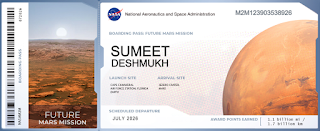
Kids Activity- Send your name to Mars.

Image
 How to send your name to Mars ? Step 1 -Open Below Link https://mars.nasa.gov/participate/send-your-name/future Step 2- Fill out below details  (1)First Name, (2)Last Name, (3)Country, (4)Postal code (5)Email Step 3- Click on "SEND MY NAME TO MARS" Button. Your Name will be stored on a micro-chip and this micro-chip is placed on the Rover. Once you have done above 3 steps, then view your "Boarding Pass" by visiting below website and filling out details ( same details you have mentioned in Step 2) https://mars.nasa.gov/participate/send-your-name/find Below is my Boarding Pass ! Below is translation of above text in Portuguese by Jessica(Dentist from Brazil,In Rio de Janeiro) Atividade para crianças - Envie seu nome para Marte Como enviar seu nome para Marte? Passo 1 - Abra o link abaixo https://mars.nasa.gov/participate/send-your-name/future Passo 2 - Preencha as informações abaixo (1)Nome (2)Sobrenome (3)País (4)Código Postal (5)E-mail Passo 3 - Clique no botão “...

Kids Activity - Look for dark plains of Moon

Image
With the help of image below try to spot the different dark plains on the Moon. These dark patches are formed because of volcanic eruption in ancient times. This Activity could be done with / without Binocular /Telescope.   Cropped Image credit-Photo by  Neven Krcmarek  on  Unsplash  . Further Arrows and Names of dark plains are added by Me. Original Image credit-Photo by Neven Krcmarek on Unsplash  . Further Arrows and Names of dark plains are added by Me. Below is translation of above text in Portuguese by Elaine (Teacher from Brazil, In São Paulo) Atividade para crianças - Procure planícies escuras da lua  Com a ajuda da imagem abaixo tente localizar as diferentes planícies escuras da lua.  Essas manchas escuras são formadas por causa da erupção vulcânica nos tempos antigos.  Esta atividade pode ser realizada com / sem binóculo / telescópio. Nota; Cropped Image credit-Photo por Neven Krcmarek no Unsplash.  Mais setas e nomes de ...

Nebra Sky Disk- Oldest Sky Disk With Celestial Objects

Image
 Nebra Sky Disk is made up of Bronze, it is 30 centimeter wide. Important figures on the disk- 1)Sun or Full Moon (full circle) 2)Crescent Moon (crescent circle) 3)Pleiades Constellation (group of 7 stars - small circles) 4)Other stars (other small circles) 5)2 Golden arcs (at the border of disk) -Angle between Solstices (currently 1 seems to be missing at opposite side) 6)1 Golden arc (thin shape)- Is not yet fully known Credit-By Dbachmann, CC BY-SA 3.0, https://commons.wikimedia.org/w/index.php?curid=1500795 This disk was found in Mittelberg forest in germany and the disk is though to be from period 1600 - 1560 BCE Activity for School  kids-  Draw the above disk on card board. Fore more information visit below link. https://en.wikipedia.org/wiki/Nebra_sky_disk

Free Astronomy Courses On Coursera

Image
 Note - Content is free but you may have to pay for certificate. There are many astronomy courses , refer to below link- https://www.coursera.org/search?query=astronomy&=

Supernova recorded on Ancient Sky Chart.

Image
Important take away from Mayank Vahia Sir and his team's analysis related to carvings on the ancient rock- 1) Half star is Supernova - HB9  2)Hunter with Bow and arrow is located in Orion constellation 3)Hunter with Spear is of  part of Pisces constellation   4)Stag animal is  Taurus constellation 5)Dog animal is Andromeda galaxy   6)Full star is Sun/ Full Moon The Stone carving was found in  Burzahama(kashmir) with  oldest settlements date back to about 4325(+/-115) BCE . Note- Permission has been granted by Mayank Vahia Sir to publish his analysis in this blog If you are interested to get more details refer to below research paper https://www.tifr.res.in/~archaeo/papers/Prehistoric%20astronomy/Oldest%20Supernova%20record%20in%20Kashmir.pdf Below is translation of above text in Portuguese by Elaine (Teacher from Brazil, In São Paulo) Supernova registrada no  Mapa Celeste Antigo  Uma lição importante da análise do senhor Mayank Vahia e ...

Sagitta - Constellation

Image
 Sagitta is lesser know constellation in night sky with dim stars in northern hemisphere sky Image  credit  IAU and Sky & Telescope magazine (Roger Sinnott & Rick Fienberg)  ( https://en.wikipedia.org/wiki/Sagitta#/media/File:Sagitta_IAU.svg) Alpha and Beta star ( of 4.38 magnitude) are visible yellow stars. But brightest star is gamma star. It has one interesting object M71 / NGC 6838. It is loose globular cluster visible through binoculars. credit -By en:NASA, en:STScI, en:WikiSky - en:WikiSky's snapshot tool - [1], Public Domain, https://commons.wikimedia.org/w/index.php?curid=4490982 To know more about the constellation and M71 visit below links- https://en.wikipedia.org/wiki/Messier_71 https://en.wikipedia.org/wiki/Sagitta Below is translation of above text in Portuguese by Elaine (Teacher from Brazil, In São Paulo) Constelação Sagitta  Sagitta é uma constelação menos conhecida no céu noturno, com estrelas fracas no céu do hemisfério norte....

Sunspots - Video and Photo - from Gurudev Observatory

Image
Sunspots - Video and Photo - from Gurudev Observatory Key Points from video 1)Magnetic field from Sun is always changing. 2)Sunspot "AR 2786" is 12x( times more) of Earth .   Below is the beautiful video of Sun which shows 3 sunspots. It was recorded by Gurudev Obsevatory on 27th Nov 2020.  Below is the still image of 3 sunspots Note- Credit for Video and image goes to Gurudev Obsevatory. Special Thanks to Divyadarshan D Purohit - Director of Gurudev Obsevatory for giving permission to use the video and upload photo to this blog. Please feel free to visit website of Gurudev Observatory- https://www.gurudevobservatory.co.in/ Below is translation of above text in Portuguese by Elaine (Teacher from Brazil, In São Paulo) Manchas solares - vídeo e foto - do Observatório Gurudev  Pontos principais do vídeo   1) O campo magnético do Sol está sempre mudando.  2) A mancha solar "AR 2786" é 12x (vezes mais) o tamanho da Terra.  Abaixo está o lindo vídeo do Sol q...

Hertzsprung–Russell diagram - Star classification based on its brightness v/s temperature.

Image
 Hertzsprung–Russell diagram is scatter plot based on Star's Luminosity(brightness) v/s Temperature. Image credit-http://lcogt.net/spacebook/h-r-diagram/ 1)Main Sequence Stars- They burn their hydrogen core and their position depends on their mass. See the diagonal distribution in the diagram. 2)Red & Orange Giants- They are expanding star. They are at the end or final stage of their lives. 3)Red Super Giants- Most massive star swells and becomes Super Giants as they get old. 4)White dwarfs- They are hot star with the faint core. For example when Sun like star will burn out , they would become White dwarf. Below image show some popular Night Sky Star plotted in HR diagram. credit-https://www.space.fm/astronomy/starsgalaxies/hrdiagram.html To know more in detail about HR diagram visit below links https://en.wikipedia.org/wiki/Hertzsprung%E2%80%93Russell_diagram https://astronomy.swin.edu.au/cosmos/H/Hertzsprung-Russell+Diagram Below is translation of above text in Portuguese ...

Canes Venatici - Constellation

Image
 An interest constellation in northern sky. It has distinct 2 stars. The several other stars has more than 4.5 magnitude. Image credit-By IAU and Sky & Telescope magazine (Roger Sinnott & Rick Fienberg) - [1], CC BY 3.0, https://commons.wikimedia.org/w/index.php?curid=15406242 The interesting objects in this constellation are Alpha Star(Cor Caroli)  is binary Start system with with visible magnitude of 2.8 and 5.6.  Could be seen through Binoculars or telescope. M3 is Globular Cluster(6.2 magnitude)   It contains 274 known variable Stars. Image Credits-By ESA/Hubble, CC BY 4.0, https://commons.wikimedia.org/w/index.php?curid=77858805 M51 is Whirlpool Galaxy ( interacting grand-design spiral galaxy) with a Seyfert 2( active galactic nucleus). It has 8.4 magnitude.  Below is  Whirlpool Galaxy invarious lights – Observed in Various Light a) 0.4; 0.7 μm – b) vis-blue/green; ir-red – c) 3.6; 4.5; 8 μm – d) 24 μm Image Credit -By NASA/JPL-Caltech...

iTelescope ,Commercial Telescope, for Independent Research/Usage etc.

Image
 If you are interested to use Professional Telescopes(remotely-over the internet), There is another way, you may you one or several telescope for Science, Research, Astro -photography. This telescope would be in  advantage, when you are interested in carrying out independent research etc. But this comes at price/cost. To check the pricing and telescope details refer to below site. https://www.itelescope.net/ Below is translation of above text in Portuguese by Jéssica (Dentist from Brazil, Rio de Janeiro) iTelescópio, telescópio comercial, para pesquisas e usos independentes  Se você está interessado no uso de telescópios profissionais (de uso remoto), há outra maneira, você pode usar um ou vários telescópios para uso científico, pesquisa ou astrofotografia. Esse telescópio é vantajoso se você está interessado em realizar uma pesquisa independente, etc. Mas isso tem um preço. Para verificar os preços e informações sobre o telescópio consulte o site abaixo: https://www.itel...

Stonehenge - An Archeoastronomy Interest Site

Image
 Stonehenge is prehistoric Archeoastronomy Site. Image Credit & Source: Self Lot of research is going on in decoding the the alignment of Stone with respect to Sun , Moon and the Seasons.  If you are interested more to know about this ancient site then go through the below reference links. Reference links- https://en.wikipedia.org/wiki/Archaeoastronomy_and_Stonehenge http://www.stonehengeandaveburywhs.org/assets/Stonehenge.LowRes.pdf http://publications.thebritishacademy.ac.uk/pubs/proc/files/92p203.pdf Below is translation of above text in Portuguese by Elaine (Teacher from Brazil, In São Paulo) Stonehenge é um sítio de arqueoastronomia pré-histórico. Muitas pesquisas estão sendo feitas para decodificar o alinhamento da Pedra em relação ao Sol, à Lua e às Estações.  Se você estiver interessado em saber mais sobre este site antigo, vá até os links de referência abaixo. Links de referência-  https://en.wikipedia.org/wiki/Archaeoastronomy_and_Stonehenge  ...

Hyperion - Saturn's Strange Moon

The shape of the moon is irregular and looks much like a potato shape. Possibly it is thought to be a remnant of a larger moon that was destroyed by a major impact. Image Credit Source-Nasa. Enjoyed 3D model view of Hyperion by turning the object. Below is translation of above text in Portuguese by Taynna(medical student from Brazil) A forma da lua é irregular e parece a forma de uma batata. Possivelmente pensa-se assim por ser um pedaço remanescente de uma lua maior que foi destruída por um impacto grande.  Créditos da imagem Source-Nasa Aprecie o modelo de visão 3D . Thanks Taynna 😊 

About - Betelgeuse Star

Image
 Betelgeuse Star ( also called Alpha Orion) is the 10th brightest star in the night sky. Looks reddish in color and magnitude varies from +0.0 to +1.6.                                                                  Image credit:NASA Easy to spot - locate Orion constellation and try to locate Reddish color Star. In this image it appears in top left. To see the changes in magnitude over past decade(from 1911 to 2001) refer to below image- image credit and link - https://www.aavso.org/sites/default/files/images/LTbetelgeuse.jpg Below is translation of above text in Portuguese by Elaine (Teacher from Brazil, In São Paulo) Sobre  a Estrela Betelgeuse    A estrela Betelgeuse (também chamada de Alpha Orion) é a décima estrela mais brilhante do céu noturno.  Parece averme...

Radio Meteor Zoo - An interesting Project

Image
This is very interesting citizen science project for those who want to interested to identify radio meteor from the radio spectogram. Refer to the link to know more  https://www.zooniverse.org/projects/zooniverse/radio-meteor-zoo Below is translation of above text in Portuguese by Elaine (Teacher from Brazil, In São Paulo) Radio Zoo Metoro - Um projeto interessante Este é um projeto de ciência cidadã muito interessante para aqueles que desejam se interessar em identificar meteoros de rádio a partir do espectograma de rádio.  Consulte o link para saber mais,  https://www.zooniverse.org/projects/zooniverse/radio-meteor-zoo  

Lunar/ Moon libration - An interesting Topic !

We all know we see one side of the moon due to its same rotation and revolution period. In general sense far side of the moon is not possible unless there is rover or satellite to take the photos. Lunar libration at its longitude happens happens when Moon's rotation sometimes leads and sometimes lags its orbital position, it can reach to 7°54′ in amplitude.   Lunar libration at its latitude happens because of slight inclination (about 6.7°) between the Moon's axis of rotation and the normal to the plane of its orbit around Earth.   Diurnal libration is a small daily oscillation due to Earth's rotation, which carries an observer first to one side and then to the other side of the straight line joining Earth's and the Moon's centers, allowing the observer to look first around one side of the Moon and then around the other.  Overall this give opportunity to see more surface of a moon at different times. So instead of 50 % we are able to see (over the time) 59% of...

What is Kuiper belt?

Image
  Kuiper belt is a circumstellar disc in the outer Solar System.  Image source and credit:https://en.wikipedia.org/wiki/Kuiper_belt It begins at  30 AU from the sun and stretch till 50 AU from the sun. Analysis indicates that Kuiper belt objects are composed of a mixture of rock and a variety of ices such as water, methane, and ammonia. Want to know more about object in kuiper belt, refer to below list-https://en.wikipedia.org/wiki/List_of_the_brightest_Kuiper_belt_objects Note- Information is based on wiki link-https://en.wikipedia.org/wiki/Kuiper_belt Below is translation of above text in Portuguese by Elaine (Teacher from Brazil, In São Paulo) O que é o cinturão de Kuiper?  O cinturão de Kuiper é um disco circunstelar no Sistema Solar exterior. Começa a 30 UA do sol e se estende até 50 UA do sol.  A análise indica que os objetos do cinturão de Kuiper são compostos de uma mistura de rocha e uma variedade de gelo, como água, metano e amônia.  Quer sab...

Ceres - Dwarf Planet.

Image
Image source & Link-https://photojournal.jpl.nasa.gov/catalog/PIA21906   Ceres( with diameter 940 km) having its own gravity is the object in asteroid belt. It is falls in the category of dwarf planet. Its apparent magnitude varies from 6.7 to 9.3. To more more in depth about its interesting surface features refer to below web site in note section below. Note -https://en.wikipedia.org/wiki/Ceres_(dwarf_planet) All above information is taken from above link. Below is translation of above text in Portuguese by Elaine (Teacher from Brazil, In São Paulo) Ceres - Planeta Anão Ceres (com diâmetro de 940 km) com sua própria gravidade é o objeto no cinturão de asteróides.  Ele se enquadra na categoria de planeta anão.  Sua magnitude aparente varia de 6,7 a 9,3.  Para obter mais detalhes sobre suas características de superfície interessantes, consulte o site abaixo na seção de notas abaixo. Nota: Fonte da imagem e Link-https: //photojournal.jpl.nasa.gov/catalog/PIA21906

What is NGC catalogue?

You might have often seen names of nebulae, galaxies staring with prefix "NGC" such as "NGC xxxx".  NGC refers to "New General Catalogue" for deep sky objects including including galaxies, star clusters, emission nebulae and absorption nebulae.   The list has 7,840 objects, below is exhaustive list of objects https://en.wikipedia.org/wiki/List_of_NGC_objects  The Revised New General Catalogue and Index Catalogue (abbreviated as RNGC/IC) is a compilation made by Wolfgang Steinicke in 2009. It is a comprehensive and authoritative treatment of the NGC and IC catalogues.   Note - information is from below wiki link  https://en.wikipedia.org/wiki/New_General_Catalogue Below is translation of above text in Portuguese by Elaine (Teacher from Brazil, In São Paulo) O que é o catálogo NGC? Você deve ter visto frequentemente nomes de nebulosas, galáxias com o prefixo "NGC", como "NGC xxxx".  NGC refere-se ao "Novo Catálogo Geral" para ob...
Mars Weather Latest Refer below to latest weatherupdates from Mars taken by NASA

What is Oort cloud ?

Image
 Oort cloud is thought to be shell of icy objects. Image source: Oort Cloud Illustration – laurinemoreau.com( https://space-facts.com/oort-cloud/#:~:text=The%20Oort%20Cloud%20is%20an,comets%20that%20have%20been%20observed.) It is located in the farthest reach of our solar system at around 2000 AU. Its range is form 2000 AU(inner limit) to 200,000(outer limit). It may get  disrupted by the nearby passage of a star, nebula, or by actions in the disk of the  Milky Way . Note - Above information is based on below link- https://space-facts.com/oort-cloud/#:~:text=The%20Oort%20Cloud%20is%20an,comets%20that%20have%20been%20observed. limit range from wiki link - https://en.wikipedia.org/wiki/Oort_cloud Below is translation of above text in Portuguese by Elaine (Teacher from Brazil, In São Paulo) O que é a nuvem Oort?  A nuvem de Oort é considerada uma concha de objetos gelados. Ele está localizado no alcance mais distante do nosso sistema solar em cerca de 2.000 UA...

The Mars Society

Image
  Mars Society is active organization encouraging future settlement on planet Mars. It host lots of competition and challenges. There  are lots of outreach activities going on and you will be interested in it. If you are interested on latest updates please refer to below website  there is lot on the website  https://www.marssociety.org/

Moon phase chart

Image
  Moon phase chart is often handy. It tells the phase of moon and tides. Always plan night sky observation as per moon phase. Check the validity of such chart before buying.

Jupiter trojan

Image
 The Jupiter trojans are a large group of asteroids that share the planet Jupiter's orbit around the Sun. Image source - wiki link mentioned in the Note section As per new estimates, the total number of Jupiter trojans with a diameter larger than 2 km is  1)6,300 ± 1,000 in the L4(lagrange point) swarms and  2)3,400 ± 500  and L5(lagrangepoint) swarms Each swarm stretches for about 26° along the orbit of Jupiter, amounting to a total distance of about 2.5 AU Note- Information is based on below wiki link- https://en.wikipedia.org/wiki/Jupiter_trojan#Physical_properties

Leonid Meteor Shower

Image
 Leonid meteor shower is very spectacular night sky event.  Image source: https://www.timeanddate.com/astronomy/meteor-shower/leonids.html One may observer 100s/ 1000s of shooting star in clear dark night sky. When the earth passes through the debris created by 55P/Tempel–Tuttle comet, the debris is attracted towards earth gravity. As this debris enters earth's atmosphere, due to friction it produces colorful event as per the chemical composition of debris material. The event is observed in Mid November . Note- For more details please visit below website and change the location as per you destination to get time  and direction the of shower. https://www.timeanddate.com/astronomy/meteor-shower/leonids.html  

Galileo's Jupiter Moon observation & its telescope details used for observing Jupiter's moon

Image
  Draft of a letter to Leonardo Donato, Doge of Venice, August, 1609, and Notes on the Moons of Jupiter, January 1610. The above image should should be keep in mind the way Galileo saw the Jupiter and its moon, as the moon appeared as tiny spot. In March 1610, Galileo published his discoveries of Jupiter’s satellites and other celestial observations in a book titled  Siderius Nuncius (The Starry Messenger) Galileo used a crude refracting telescope(with  20x magnification ) for his observations for Sidereus nuncius. It had a convex objective lens and a concave eyepiece in a long tube. Note- Image Of Draft latter is taken for below website https://solarsystem.nasa.gov/news/307/galileos-observations-of-the-moon-jupiter-venus-and-the-sun/ Telescope details from below website- https://www.atnf.csiro.au/outreach/education/senior/astrophysics/galileo.html https://www.atnf.csiro.au/outreach/education/senior/astrophysics/galileo.html Below is translation of above text in...

Moon Society

Image
  https://www.moonsociety.org/ Moon society is an organization which encourages future human settlements on the Moon. They host conference and moon challenges( competitions which has prizes.) you may join the organization ( refer to link ,there could be joining fees ) also publish your ideas. Below is translation of above text in Portuguese by Elaine (Teacher from Brazil, In São Paulo) Sociedade Lunar  A sociedade lunar é uma organização que incentiva futuros assentamentos humanos na lua.  Eles organizam desafios de conferências e lunares (competições com prêmios).  Você pode ingressar na organização (consulte o link, pode haver taxas de adesão) e também publicar suas idéias. https://www.moonsociety.org/

Dunhuang chart - Ancient Sky Chart

Image
Image above image and below information source- http://irfu.cea.fr/dap/Phocea/Vie_des_labos/Ast/ast.php?t=actu&id_ast=2615 Dunhuang Chart is one of the oldest sky chart with more than 1300 stars. It is  was composed around the years +(649-684). It was found inside "Buddhist Mogao cave complex". If you are interested to research more, follow below links- http://irfu.cea.fr/dap/Phocea/Vie_des_labos/Ast/ast.php?t=actu&id_ast=2615 https://en.wikipedia.org/wiki/Dunhuang_Star_Chart  

Astropy - Python Library for Astronomy projects.

Astropy is very useful and important python programing library for Astronomers and Astrophysicists. It provides many useful functions and astronomical constants. You can use functions in the library for your Astronomy projects which may be related to calculations or working with  FITS image file such as accessing information form it. Click on the below link to know more https://www.astropy.org/

Are we alone? - Help the search in Breakthrough Initiatives listen Space Program.

Image
https://breakthroughinitiatives.org/ Are we alone or are their any habitable planets - Breakthrough Initiatives has several space program which are trying to find the answer. "If You" are interested in the program(rather want help the Cause ) then refer to below link https://breakthroughinitiatives.org/initiative/1   

Infrared v/s Normal Image Comparison of Andromeda galaxy

Image
The Infrared photo of Andromeda galaxy highlights cooler region of galaxy. Note - Image credit and source given below The Andromeda Galaxy, viewed using conventional optics and IR. Credit: Kitt Peak National Observatory source :https://www.universetoday.com/33475/messier-31-andromeda/

What is Messier Catalogue?

Image
Messier Catalogue consist of 110 astronomical objects(called Messier objects which start with letter "M"). It was created by Charles Messier, and later publish around 1774. This catalogue consists : nebulas, planetary nebulas, open clusters, globular clusters, galaxies, mostly of Northern Hemisphere. Below is the complete list- Messier Objects (M1 - M110): M1 - Crab Nebula (Supernova Remnant) in Taurus M2 - Globular Cluster in Aquarius M3 - Globular Cluster in Canes Venatici M4 - Globular Cluster in Scorpius M5 - Globular Cluster in Serpens M6 - Butterfly Cluster (Open Cluster) in Scorpius M7 - Ptolemy's Cluster (Open Cluster) in Scorpius M8 - Lagoon Nebula (H II Region) in Sagittarius M9 - Globular Cluster in Ophiuchus M10 - Globular Cluster in Ophiuchus M11 - Wild Duck Cluster (Open Cluster) in Scutum M12 - Globular Cluster in Ophiuchus M13 - Hercules Globular Cluster in Hercules M14 - Globular Cluster in Ophiuchus M15 - Globular Cluster in Pegasus M16 -...